This is an old revision of the document!
Table of Contents
Statistical Sleight of Hand: How Misrepresentation Distorts Prison Statistics
The Transmisic Claim
“Analysis of Ministry of Justice (MoJ) data from 2019/2020 indicated that approx 59% of trans women in prison had at least one conviction for a sexual offence against 17% of other men in prison.”
Or something similar.
The Numbers Behind Those Percentages
| Population | Total | Sex Offenders | Percentage |
|---|---|---|---|
| Trans women prisoners | 129 | 76 | 58.9% |
| Cisgender men prisoners | ~78,781 | ~13,234 | 16.8% |
What This Actually Shows
- 76 trans women sex offenders in prison
- ~13,234 cisgender men sex offenders in prison
The percentage comparison hides the real disparity: You're comparing 76 to 13,234—a completely different scale.
For this reason, things like per capita and ratio/percentage comparisons are often prone to over-representation and are therefore misleading. There is nuance here: there is no denying an over-representation; however, when the numbers are so disparate, the over-representation doesn't matter. It may be statistically significant, but it is practically irrelevant.
Note: Keep in mind that “sex offence” in the UK is a rather broad bucket, which includes various charges surrounding being paid for, and participating in, sex work. Trans women, on average, are more likely to take sex work as a means of survival. So there is an element of appeal to emotion and or loaded language when making the shocking or damning sounding claim of “sex offense conviction(s).”
The Classroom Analogy
Imagine two classrooms:
- Classroom A: 129 students total, 76 like chocolate = 58.9%
- Classroom B: 78,781 students total, 13,234 like chocolate = 16.8%
If you say “Classroom A likes chocolate more!” you'd be wrong. Classroom B has way more chocolate lovers in absolute numbers; it just looks smaller as a percentage because the classroom is gigantic.
That's exactly what the 59% vs 17% comparison does. It hides the massive difference in group sizes.
Why Per-Capita Distorts the Picture
Much of the time, someone thinks they are clever and will say “it's like you don't understand per-capita.” This is a different sleight of hand ploy, but related because it still depends on a large disparity between populations (denominators).
The Problem
| Population | Total Size |
|---|---|
| Trans women population | 48,000 |
| Cisgender men population | 29.2 million |
With such different population sizes:
- A change of just 6 convictions flips the trans women rate dramatically
Trans women:
- 76 convictions ÷ 48,000 = 15.83 per 10,000
- 82 convictions ÷ 48,000 = 17.08 per 10,000 (a 7% change in rate from just 6 more cases)
Cisgender men:
- You'd need hundreds of extra convictions to move the needle meaningfully
- 13,234 ÷ 29,177,200 = 4.54 per 10,000
- You'd need ~13,400+ convictions to get to 4.6 per 10,000
Yet from this comparison, it looks like trans women will offend 3.5 times more! That sounds really bad!
Why This Is Misleading
That 3.5 times more is concerning a fraction of a fraction of a percent of a larger population. It concerns 76 trans women out of 48,000 trans women, which is a fraction of 0.1% of the UK population.
Some will argue “but per-capita shows over-representation!” That's true; but when comparing populations that differ by a lot (600x or so), small absolute changes produce large percentage swings. Like those six extra convictions mentioned above? They disproportionately inflated the trans women numbers versus the cisgender men.
And remember, the policy question isn't “which group's percentage is higher?” It's “who commits these crimes?”
Answer: 99.43% cisgender men, 0.57% trans women.
When per-capita is abused (which it absolutely has been throughout history), over-policing of minority groups occurs while the majority of the people actually doing the crime are ignored. Decision-makers believe the data shows them where the real trouble spots/groups are.
Note: One could argue that the per-capita rate does not show over-representation of a group *for committing* the crimes, but *being convicted* for the crimes. These are two different things—but that's a separate issue.
The Math in Context
- Trans women population: 48,000
- Trans women as % of UK population: 0.1%
- Sex offense trans women in prison: 76
Breakdown
76 out of 48,000 trans women = 0.158% of trans women population
Now, what fraction of the TOTAL UK population is this?
- UK population: ~59.6 million
- 76 ÷ 59,600,000 = 0.0000012755 = 0.000128%
- Or: 1 in 784,000 people in the UK
Once you put it into the right context, it turns out to be not more statistically significant than noise.
What IS a Fair Comparison?
Population comparison is perfectly fine when you are talking about a population as a whole! To stay in the same frame of reference, compare trans women to cisgender men in terms of who has the greater proportion of sex offences as a part of their conviction.
First, total up all those with sex offenses: 13,234 + 76 = 13,310
Now find your ratios and put it into a proper chart:
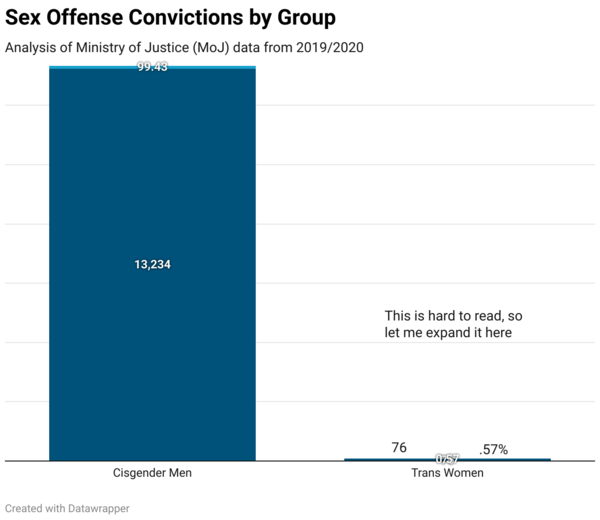
| Group | Total Sex Offenders | Percentage of All Sex Offenders |
|---|---|---|
| Cisgender Men | 13,234 | 99.43% |
| Trans Women | 76 | 0.57% |
| Total | 13,310 | 100.00% |
Now when we ask the question “Who is responsible for the most sex offenses based on convictions in prison?” we can look at:
- The absolute numbers
- The ratio of group A and group B to the category in question
- Determine which one you have more of
- Determine which one is a greater risk (or not)
The Problem with Misused Statistics
If we took the per-capita rate or the original 59% vs 17% claim, we could end up focusing a lot of resources and police on trans women in an attempt to combat sex offenses in general when they are:
- The smallest population of offenders
- The least compared to the population as a whole
Note: Cisgender women are intentionally left out here due to limited reliable data for this comparison. There is also an infographic that goes around showing per-capita rates—this argument applies to that as well, though with different numbers and data. This has been well covered and debunked already, but in essence, they are using per-capita sleight of hand. If they used absolute numbers and percentages categorized appropriately, it would not be to their advantage.
Summary
“There are lies, damned lies, and statistics”
When statistics are presented without proper context or with misleading comparisons between vastly different group sizes, they distort reality. The fair way to present data is:
- Use absolute numbers when the populations differ significantly
- Use ratios/percentages of the total within the category being measured
- Always contextualize within the total population affected
- Ask: “What is the actual policy question?” and ensure the statistics answer that question, not a misleading version of it


